




A Verdict
Four dimensions scored: customer clarity, problem sharpness, evidence strength, and risk. You'll know exactly where your idea holds and where it breaks.
Working Backwards is the Amazon process behind Kindle, Prime, AWS, and the most-cited product memos in tech.
Four dimensions scored: customer clarity, problem sharpness, evidence strength, and risk. You'll know exactly where your idea holds and where it breaks.

Headline, problem, solution, and customer quote - written as if the product already shipped. The format Amazon uses to align teams before a line of code gets written.

What your future customer will ask, and what your board will challenge. Honest answers to both, surfaced before they become blockers.

Vision, goals, requirements, and milestones - structured so an engineer can open it and start working without a single clarification call.
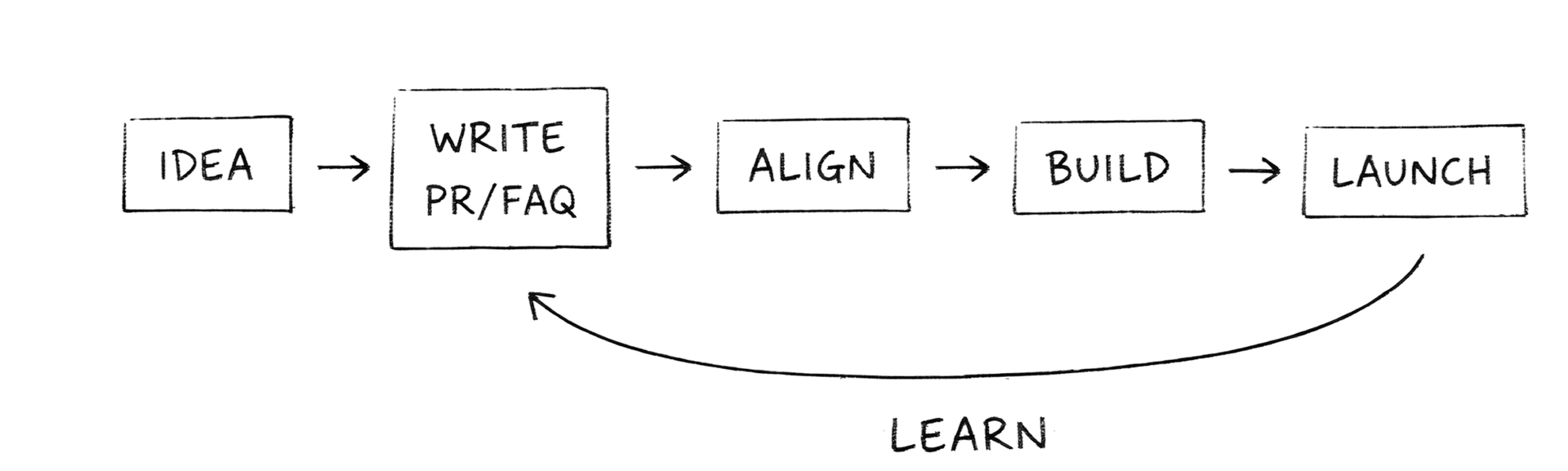
Working Backwards is a process for deciding whether to build something, and how to build it, by writing the press release before writing any code. Jeff Bezos and the Amazon leadership team developed it around 2004. Most of Amazon's biggest products since then came through it.
The idea is simple. Before you build anything, you write the press release for the launch. You write it from the customer's perspective. You write the FAQ a customer would ask, and the FAQ a board would ask. You write all of it as if the product already exists. Then you read it and ask: so what?
If the document does not describe a product that is meaningfully better, faster, easier, or cheaper than what is already out there, you do not start. You change the inputs and write it again.

Slides let you wave your hands. A press release does not. If you cannot write a clear sentence about who the customer is and why they care, you do not understand the problem yet.
When the format starts with "for the customer," you cannot start anywhere else. Willpower is not required. The artifact does the work.
A bad PR/FAQ takes 30 seconds to read and reject. A bad product takes 18 months to build and reject. The asymmetry is the point.
The PR/FAQ also has a known failure mode. It does not save bad inputs. The Fire Phone team wrote one. They built against it. The product still failed because the "customer" was a fantasy and the "problem" was Amazon's, not the customer's. The format is not magic. The honesty of the inputs is.